Stage 1 · Stage 2
Stage 1 and Stage 2, without the guesswork
A stage isn’t a power figure. It describes what hardware the calibration is built for. Here’s what each one changes, what Stage 2 needs on the car, and how we check the result.
Create a free accountRead the full article
Side by side
What changes between stages
| Stage 1 | Stage 2 |
|---|
| Hardware | Stock | Upgraded intercooler, intake and exhaust; sometimes fuel system |
| Calibration | Boost, fuel, timing and torque limits within the margins of the stock parts | Recalibrated for the airflow and fuel the new parts allow |
| Example | F-150 3.5 EcoBoost: 395 → 438 hp, 480 → 531 lb-ft (catalog reference) | Depends on the parts fitted; we quote nothing until we see the list |
| Validation | Road test; a datalog is recommended | Datalogs required, with adjustments if needed |
| Typical turnaround | ~35 min diesel, ~2 h gas | Depends on the job |
Catalog figures are references. Real results depend on the vehicle’s condition, the fuel and the hardware.
Stage 2 hardware
Parts first, then the file
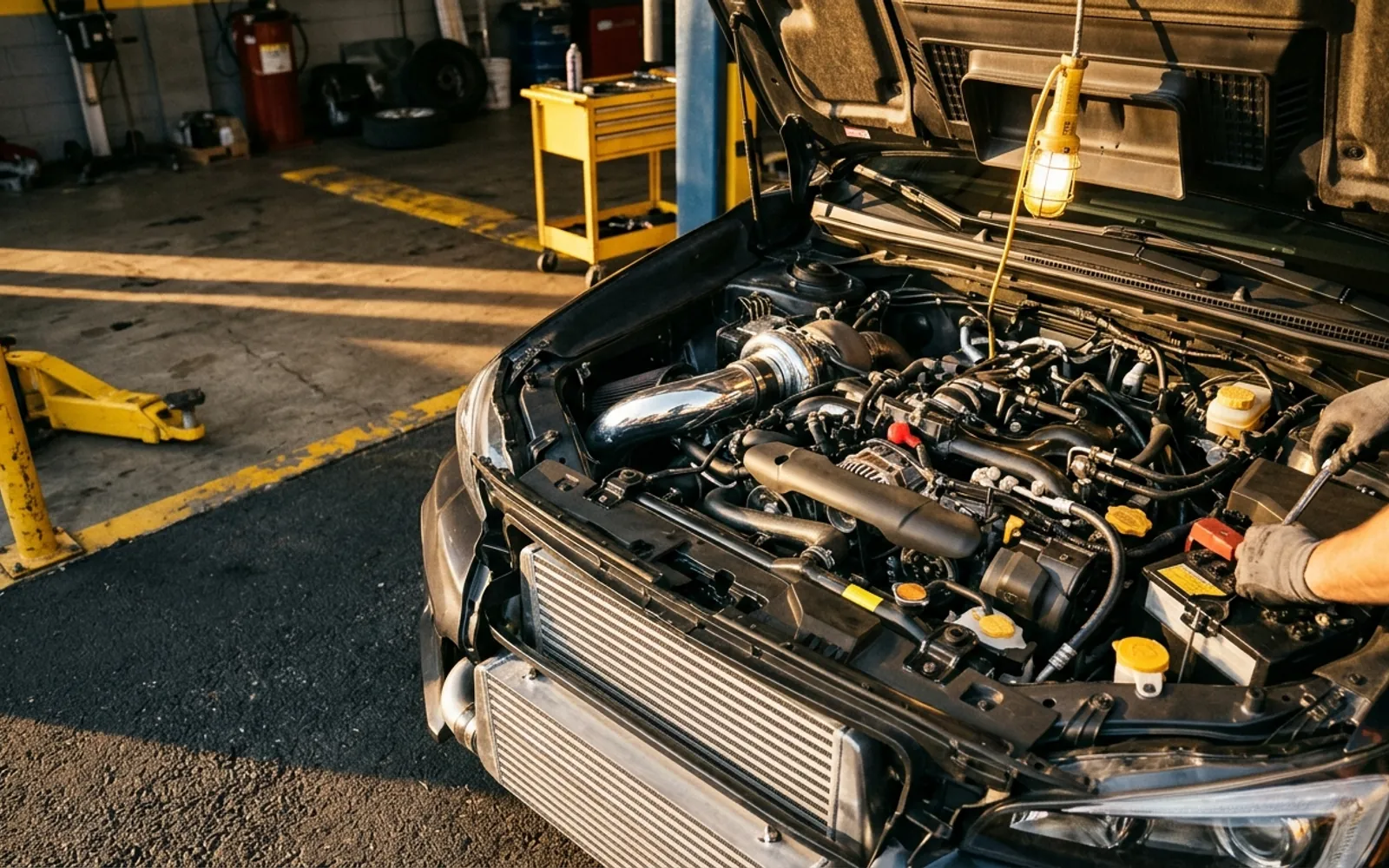
- Intercooler. More boost means hotter charge air. A larger intercooler keeps intake temperature down on repeated pulls and on hot days.
- Intake. Only worth it when the stock intake is a measured restriction. On its own it rarely changes the calibration.
- Exhaust or downpipe. Less back-pressure lets the turbo spool and flow more. On road vehicles it must keep the catalytic converter.
- Turbo. A larger or hybrid turbo moves the job past Stage 2. Send the exact part number.
- Injectors and fuel pump. Needed when the target fueling exceeds what the stock parts can deliver at full duty.
- Clutch and transmission. Often the real limit. A stock clutch that slips will not survive Stage 2 torque.
Exhaust parts on road vehicles in the US and Canada
On vehicles driven on public roads in the US and Canada, the exhaust must keep the catalytic converter and every other emissions system installed and working. We calibrate Stage 2 for exhaust setups that meet that rule. Check that any aftermarket part is legal for your vehicle and your state or province before you fit it.
Risks
When not to tune
More power means more load on every part between the pistons and the tires. That trade-off is fine on a healthy vehicle with the right parts, and a bad idea otherwise.
- High mileage with no service history, oil consumption or blow-by.
- Active fault codes, misfires, boost leaks or a slipping clutch.
- Poor or inconsistent fuel quality that you can’t control.
- A vehicle still under a warranty you need to keep, or a leased vehicle.
- Constant towing at the maximum rated weight: ask for a towing calibration, not a power one.
Validation
How we check a file with datalogs
Log the car on the stock file
A full-throttle pull in a fixed gear, from low rpm to the limiter, gives us a baseline.
Write the file and repeat the same pull
Same gear, same road, similar temperature. Log boost requested and actual, lambda, timing and knock correction, rail pressure, intake temperature and, on diesels, EGT.
Send both logs on the order ticket
The technician compares them against the targets in the file.
Adjust if the data asks for it
Knock, boost overshoot or high intake temperatures lead to a revised file. Clean logs mean the job is done.
Tell us what’s on the car. We’ll build the file for it.
Create a free accountLearn to read a dyno sheet